

Why Cat Scratching Is Important for Your Cat’s Nail Health
Key Takeaways
- Scratching is instinct, not naughtiness. Cat scratching is a natural, essential behaviour that maintains claws, stretches the body and lets your feline mark their territory.
- Scratching supports healthy cat claws by shedding old outer claw sheaths — but it doesn’t replace regular nail checks and occasional trimming, especially for indoor or older cats.
- The best scratching post for cats matches your individual’s preferred orientation, material, height and stability — observe where and how they already scratch.
- Place scratching posts in meaningful, well-used spots, reward use, and never punish scratching — redirect it toward the right surface instead.
To the uninitiated, a cat raking their claws down the sofa arm looks like pure mischief. To the devoted cat carer, it’s something rather more wonderful: a deeply natural ritual that keeps your feline companion’s claws in fine fettle, their body limber and their spirit content. Understanding cat scratching is the first step toward protecting both your furniture and your cat’s wellbeing — because this behaviour isn’t optional, it’s essential.
In this guide, we’ll explore why cats scratch, how it supports healthy cat claws, and how to choose, position and encourage use of the right cat scratching post, so your discerning feline can indulge their instincts in all the right places.
Why Do Cats Scratch?
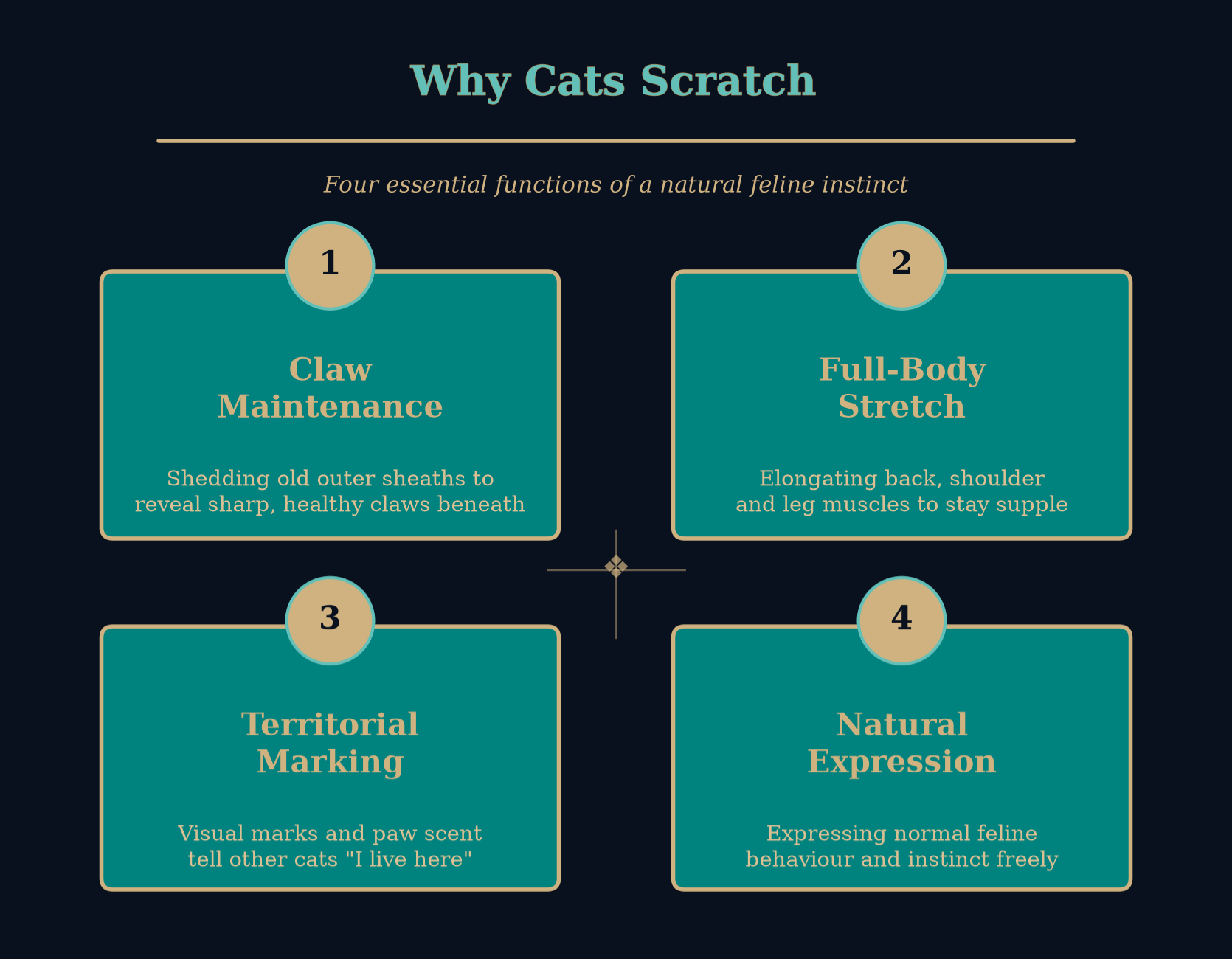
Cat scratching serves several natural physical and behavioural functions. It is not simply a cat intentionally damaging household furniture — far from it. Scratching is woven into the very fabric of feline life, addressing everything from cat nail health to emotional expression. When we understand what scratching does for a cat, we can provide the right outlets rather than fighting the instinct itself.
Maintaining the Claws
Each scratch helps a cat shed the old, worn outer layers of their claws, revealing the sharp, healthy claw beneath. It’s a form of self-care that keeps claws in good working condition — a feline manicure, if you like, performed entirely on their own terms.
Stretching the Body
Scratching is also a glorious full-body stretch. As a cat hooks their claws in and pulls, they elongate the muscles of their back, shoulders and legs. It’s the feline equivalent of a satisfying morning yoga routine — a ritual that keeps them supple and ready for their next elegant endeavour.
Marking Territory
Cats are subtle communicators, and scratching is one of their loudest statements. Both the visible scratch marks and the scent deposited from glands in their paws tell other cats, “I live here.” It’s a quiet claim on their territory — a signature written in claw and scent.
Expressing Normal Behaviour
Above all, scratching is simply what cats do. Providing access to appropriate scratching surfaces supports natural feline behaviour and lets your cat express their instincts freely. A cat denied the chance to scratch is a cat denied a part of themselves — and a contented cat is one whose nature is honoured.
How Does Scratching Support Healthy Cat Claws?
There’s a graceful relationship between regular scratching and natural claw maintenance. Each time your cat sinks their claws into a suitable surface and pulls, they help loosen and shed the dull outer sheath of the claw, revealing the fresh, healthy claw underneath. This is the heart of how scratching supports healthy cat claws.
That said, scratching doesn’t necessarily eliminate the need for nail checks or trimming. Indoor cats, who may have fewer natural surfaces to scratch and less wear on their claws, still benefit from scratching opportunities — but their claws can grow long enough to need attention. Likewise, as cats age and become less active, scratching may slow, and claws can overgrow. The wisest approach is to encourage plenty of scratching while also monitoring claw length and condition, so cat nail health is supported from both directions. Scratching keeps claws naturally conditioned; observation ensures nothing is missed.
Choosing the Best Scratching Post for Your Cat
There is no single “best” scratching post for cats — the finest choice is the one your individual cat actually wants to use. The best scratching post for cats depends on how your feline likes to scratch: their preferred orientation, material, height and the stability of the surface. Observation is your greatest tool. Notice where your cat already scratches — a carpet corner, the arm of a chair, a doormat — and choose a scratching post that mirrors those preferences.
Vertical Scratching Posts
Cats that love to stretch upward need a sufficiently tall and stable post — tall enough for them to fully extend their body, and steady enough not to wobble when they pull. A post that tips or shudders will quickly lose their confidence. Look for a height of at least 60–90 centimetres and a broad, weighted base.
Horizontal Scratchers
Some cats prefer to scratch along the floor, bearing down rather than reaching up. For these cats, a horizontal scratcher — a cardboard pad or flat sisal mat — is far more appealing than any vertical post. If your cat favours the doormat or carpet, a horizontal option is likely their style.
Scratching Materials
Common surfaces include sisal rope, corrugated cardboard and carpet. Sisal offers a satisfying, durable texture many cats adore; cardboard is inexpensive and often a hit, though it sheds; carpet can be appealing but risks teaching your cat that all carpet is fair game. From a behavioural-preference perspective, the right material is simply the one your cat returns to.
Stability and Size
A wobbling or undersized post is a post your cat may abandon. Stability and size matter as much as texture — a sturdy, generously proportioned post invites confident, full-body scratching, while a flimsy one discourages it. When in doubt, choose the more solid option.
Where Should You Put a Cat Scratching Post?
Placement can be just as important as the scratching post itself, because cats often scratch in socially or behaviourally meaningful locations. A beautifully chosen post hidden in an unused corner may go untouched, while the same post beside a favourite napping spot may become the most-used object in the house.
Place scratchers near existing scratching locations — if your cat already favours the sofa arm, put a post right beside it. Consider sleeping and resting areas, too, because cats often stretch and scratch after waking. And don’t be shy about prominent household locations: cats scratch to mark territory, so a post in a well-trafficked area can be exactly what they want. Avoid hiding all scratchers away — let your cat claim their space proudly.
For more on building a home your cat will love, explore our guide to creating a cat sanctuary at home.
How to Encourage Your Cat to Use a Scratching Post
Cats can be gently encouraged toward appropriate scratching surfaces through strategic placement, rewarding interaction and making undesirable locations less appealing — all without punishment. A little patience and playfulness go a long way.
Reward Appropriate Scratching
When your cat uses their post, offer a treat, praise or a moment of play. Positive reinforcement helps your cat associate the post with good things, making it the obvious choice over the furniture.
Make the Post Interesting
Dangle a toy near the post, or consider a cat-safe attractant such as catnip or silver vine where suitable for your individual cat. A post that’s fun to investigate is a post that gets used.
Provide More Than One Scratching Option
Different locations and orientations satisfy different scratching moods. A vertical post by the sofa and a horizontal pad by the bed give your cat choices — and choice is the essence of a contented feline.
Avoid Punishment
Punishment doesn’t address the underlying need to scratch — it simply teaches your cat to fear you or scratch in secret. Redirect instead: when claws meet the sofa, gently move your cat to their post and reward them there.
To better read the signals behind your cat’s behaviour, see our guide to reading cat body language.
Does Scratching Replace Claw Trimming for Cat Nail Health?
Scratching supports normal claw maintenance beautifully, but it doesn’t entirely replace the need for nail care. Some cats — particularly indoor, less-active or older cats — may still require claw trimming to keep their claws at a comfortable, healthy length. Think of scratching as the daily upkeep and trimming as the occasional top-up.
When Cats May Need Nail Trimming
Signs that claws may need trimming include excessively long claws that catch on fabrics, claws that curl toward the paw pad, or a tapping sound as your cat walks on hard floors. If you notice any of these, it’s time for a check.
How Often Should You Check Your Cat’s Claws?
Rather than following a rigid universal trimming interval, make regular observation your habit. A quick look every couple of weeks — ideally when your cat is relaxed — lets you catch overgrowth early and keep cat nail health on track.
Safe Claw Trimming Basics
If you trim at home, clip only the clear tip of the claw, well clear of the pink “quick” — the sensitive tissue that supplies blood and sensation. Avoiding the quick keeps the experience comfortable for your cat. If you’re unsure or uncomfortable, your vet or a groomer can help — there’s no shame in leaving it to the professionals.
When Should You Be Concerned About Your Cat’s Claws?
Most scratching and claw behaviour is perfectly normal — but some changes deserve attention. Overgrown, broken, painful or ingrown claws should be assessed rather than dismissed as ordinary scratching behaviour.
Knowing when to act keeps small issues from becoming bigger ones.
Overgrown or Ingrown Claws
Reduced scratching or mobility can allow claws to grow excessively, sometimes curving into the paw pad — a painful condition more common in older or less-active cats. If you notice overgrown or ingrown claws, seek veterinary care promptly.
Broken or Damaged Claws
Claws that are bleeding, painful or significantly damaged warrant a veterinary assessment. A broken claw can be sore and prone to infection, so it’s best not to wait.
Changes in Scratching Behaviour
If your cat suddenly stops scratching or begins scratching far more than usual, it may be worth investigating — particularly if the change comes alongside other shifts in behaviour or health. A quiet change can be an early signal that something’s amiss, and your vet can help you get to the bottom of it.
Honour the Instinct, Spoil the Cat
Scratching isn’t a problem to be solved — it’s a ritual to be respected. By understanding why your feline scratches and providing the right surfaces in the right places, you let them be gloriously, authentically themselves. For more on understanding your cat’s quiet signals, explore our guide to reading cat body language.